
Chris Rokos Leaves the UK for Greece: What Britain’s Wealth Exodus Could Mean for Ordinary Taxpayers
Subscribe to our newsletter for the latest expatriate news, views & analysis.
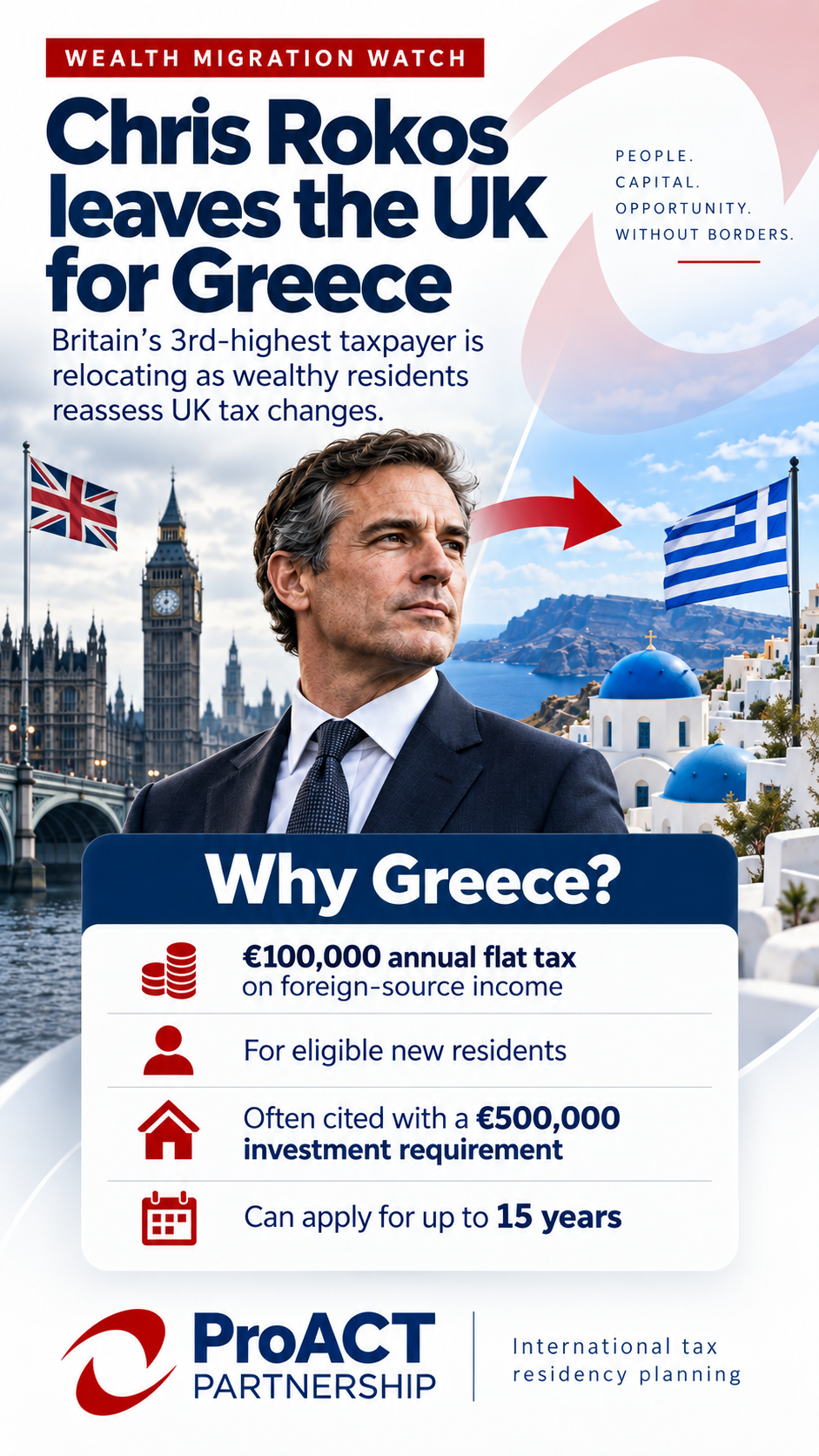
Billionaire hedge fund manager Chris Rokos is preparing to leave the UK and relocate his residency to Greece, becoming the latest high-profile wealthy individual to move away from Britain as the country's tax environment changes.
Rokos is not simply another millionaire changing address.
The founder of Rokos Capital Management was ranked Britain's third-highest taxpayer in The Sunday Times Tax List 2026, reportedly paying approximately £330 million in UK tax last year. His hedge fund manages around $20–22 billion, and reports indicate that his move will also involve establishing an office in Athens.
His destination is significant too.
Greece has been actively competing for internationally mobile wealth. Eligible new residents can potentially pay a €100,000 annual flat tax on foreign-source income for up to 15 years, subject to conditions that include qualifying investment in Greece.
But the bigger story is not Chris Rokos.
It is what happens when a country increasingly reliant on a relatively small number of very high taxpayers starts losing some of them.
Chris Rokos is part of a much wider movement
Britain has always attracted international entrepreneurs, financiers, investors and business owners.
London offered an unusual combination of global financial markets, English law, respected schools and universities, political stability, culture, professional services and access to international capital.
Tax was only one part of the equation.
But tax can become decisive when wealthy individuals have the ability to choose between London, Milan, Athens, Geneva, Monaco, Dubai or Abu Dhabi.
The UK's longstanding non-domicile regime was effectively abolished from 6 April 2025. It was replaced by a residence-based system under which qualifying new arrivals can receive relief on foreign income and gains for their first four years of UK residence after at least ten consecutive years of non-UK residence. Long-term residents, however, are now generally exposed to UK taxation on worldwide income and gains, alongside the move towards a residence-based inheritance tax system.
For some internationally mobile families, that has fundamentally changed the calculation.
And Rokos is far from the first high-profile departure.
Lakshmi Mittal
Steel billionaire Lakshmi Mittal, who had made Britain his home for approximately three decades, was reported in 2025 to be planning his departure following the changes to the UK's non-dom regime.
More recent reporting says he subsequently shifted his primary residence towards Dubai and Switzerland.
His case is particularly significant because it demonstrates how international competition works.
For someone with businesses, properties and family interests spanning multiple countries, Britain is not competing with the neighbouring county for their residency. It is competing with the world.
Nassef Sawiris
Egyptian billionaire and Aston Villa co-owner Nassef Sawiris has also relinquished his UK residency.
Sawiris now resides between Italy and Abu Dhabi, and his investment business moved more than 40 staff from London to Abu Dhabi. His family office subsequently began closing its London operation.
That illustrates a second potential consequence.
When a wealthy individual leaves, the issue is not necessarily limited to their personal tax bill.
Investment offices, employees, professional advisers, property expenditure and business activity can move with them.
Richard Gnodde
Former Goldman Sachs International chief executive Richard Gnodde, one of the City's most senior bankers, relocated from London to Milan.
The move was widely reported in connection with the UK's non-dom changes, while Italy has itself been actively attracting wealthy international residents through its flat-tax regime for overseas income.
Guillaume Pousaz
Another example is Guillaume Pousaz, billionaire founder of London-based payments company Checkout.com.
Companies House filings showed Pousaz changing his usual residence from the UK to Monaco in 2025, amid wider tax changes affecting Britain's wealthiest residents.
Shravin Bharti Mittal
Investor Shravin Bharti Mittal has also shifted his residence to the United Arab Emirates, according to Companies House records.
Individually, these are anecdotes.
Collectively, they raise a much more difficult economic question.
Why should an ordinary UK taxpayer care if billionaires leave?
It is tempting to think that the departure of a billionaire has little relevance to someone earning £30,000, £50,000 or £80,000 a year.
The UK tax system makes the relationship more direct than it might initially appear.
Britain collects a disproportionately large share of its Income Tax from high earners.
HMRC estimates that the top 1% of Income Tax payers will account for around 26.6% of all Income Tax liabilities in 2026–27.
The top 50% of Income Tax payers are expected to account for approximately 90% of the total.
That concentration is important.
A government can lose thousands of average taxpayers and barely notice the effect on total receipts. Losing a relatively small number of people with extremely large taxable incomes can have a considerably larger effect.
Rokos provides an unusually dramatic example.
A taxpayer contributing £330 million in a single year represents a level of revenue that cannot simply be dismissed because the individual concerned is extremely wealthy.
That does not mean Britain automatically loses the entire £330 million once Rokos becomes non-UK resident. UK-source income and certain UK assets and activities may remain taxable here, and future tax liabilities will depend on his exact circumstances.
But it does demonstrate just how concentrated part of the tax base has become.
Britain is already heading towards a historically high tax burden
This debate is occurring while taxation on the wider population is also rising.
The Office for Budget Responsibility forecasts that the UK's tax take will increase from 34.5% of GDP in 2024–25 to 38.5% by 2030–31.
If reached, that would represent a historic high.
The OBR says personal taxes — principally Income Tax and National Insurance — are responsible for around 2.4 percentage points of the increase. One important reason is fiscal drag: wages rise while tax thresholds remain frozen, gradually pulling more workers into tax and moving others into higher tax bands.
So ordinary taxpayers are already being asked to contribute more.
That makes the composition of Britain's tax base increasingly important.
If revenues expected from highly mobile taxpayers fall short, the Treasury ultimately has only a limited number of alternatives: collect more elsewhere, reduce expenditure, borrow more, or generate enough economic growth to expand the tax base.
This is where the departure of major taxpayers becomes relevant far beyond Mayfair.
Does taxing wealthy people more actually raise more money?
This is the central question, and the answer is more complicated than either side of the political argument sometimes suggests.
A higher tax rate does not automatically result in lower tax receipts.
Equally, a higher rate does not automatically produce the amount of additional revenue calculated by simply multiplying the new rate by the existing tax base.
People change their behaviour.
They delay transactions. They restructure investments. They work differently. They make fewer disposals. They relocate assets. And, at the very top of the wealth spectrum, some can relocate themselves.
The UK government believes its non-dom reforms will raise substantial additional revenue. Official costings estimated an additional £4.17 billion in 2026–27 and £5.895 billion in 2027–28 from the changes, although the projected annual yield changes considerably thereafter.
So it would be wrong to state as fact that abolishing the old regime has already cost the Treasury money.
It may ultimately raise money.
The real question is whether the government's assumptions about how many people stay, how many leave and how their financial behaviour changes prove accurate.
We do not yet have a complete answer.
There is not yet evidence of a mass exodus
The headlines can also get ahead of the evidence.
HMRC's latest published statistics showed around 81,900 non-domiciled and deemed-domiciled taxpayers in 2024–25, down approximately 1% on the previous year.
Rather than collapsing, their combined Income Tax, Capital Gains Tax and National Insurance liabilities actually increased by around 9% to £13.6 billion.
However, those figures largely predate the new regime that began on 6 April 2025.
That means they cannot tell us what the full behavioural response to the reforms will be.
Early evidence has suggested departures may broadly align with official assumptions rather than representing the wholesale evacuation sometimes portrayed in headlines. Complete Self Assessment data covering the first year of the new regime will provide a much clearer picture.
So the sensible conclusion is not that "all the rich are leaving Britain".
They are not.
It is that some exceptionally wealthy and economically significant individuals are leaving, and their reasons deserve attention precisely because the UK relies heavily on high earners for tax revenue.
Other countries are actively competing for Britain's wealthy residents
Britain's tax policy is not made in isolation.
Greece wants wealthy residents.
Italy wants wealthy residents.
Switzerland has long competed for them.
Monaco, Dubai and Abu Dhabi are competing for them.
These jurisdictions understand that a wealthy resident can bring more than their direct personal tax payment.
They may bring investment capital, businesses, employees, property purchases, family offices, consumption, philanthropy and networks of other internationally mobile entrepreneurs.
Greece's regime illustrates that philosophy particularly clearly.
Rather than attempting to maximise the tax charged on every euro of foreign income, it offers qualifying wealthy foreign residents certainty through a €100,000 annual charge.
Italy has adopted a similar approach with a flat annual charge on qualifying foreign income.
The policy bet is straightforward: a smaller tax charge collected from somebody who chooses to live in your country may be more valuable than a theoretically larger tax charge on somebody who chooses not to.
Whether Britain has reached that tipping point is precisely what policymakers now need to establish.
The danger is not simply losing billionaires
There is an important distinction between wealth and productive economic activity.
A billionaire moving their personal residence overseas does not necessarily mean their company leaves Britain.
London remains one of the world's major financial centres. Britain still has powerful advantages in law, language, universities, finance, technology and professional services.
But there is a longer-term risk.
If entrepreneurs increasingly build businesses in Britain but choose to realise their wealth elsewhere; if family offices move abroad; if senior financiers relocate; and if international investors begin viewing Britain as somewhere to work temporarily rather than establish permanent roots, the effect compounds over time.
The tax loss then extends beyond one individual's annual Self Assessment return.
It can affect employment, investment, consumption, property transactions, advisory businesses and future entrepreneurship.
That is much harder to measure — but potentially much more important.
What does this mean for the ordinary taxpayer?
Britain faces an uncomfortable balancing act.
There is a legitimate argument that people who live in the UK for the long term should contribute fairly to the country whose infrastructure, legal system and public services they use.
There is an equally legitimate economic question about how far taxation can rise before highly mobile people decide that another jurisdiction offers a better proposition.
Those two ideas are not mutually exclusive.
The objective of good tax policy should not simply be to establish the highest theoretical tax liability.
It should be to create a system that is fair, competitive, predictable and capable of producing sustainable revenues.
Because ultimately the Treasury needs to collect the money somewhere.
And with the OBR forecasting Britain's overall tax burden to reach record levels while frozen thresholds continue to increase the effective tax burden on employees, ordinary households have a direct interest in ensuring that the UK's largest taxpayers - and the businesses and investment surrounding them - continue to see Britain as somewhere worth staying.
Chris Rokos may therefore be more important than one £330 million tax bill
Rokos's move to Greece should not be treated as proof that Britain's tax strategy has failed.
Nor should it be dismissed as an irrelevant lifestyle decision by someone wealthy enough to live anywhere.
He was one of the country's largest individual taxpayers.
He is now choosing to establish his residency elsewhere.
Lakshmi Mittal, Nassef Sawiris, Richard Gnodde, Guillaume Pousaz and Shravin Bharti Mittal provide other examples of internationally mobile wealth moving away from the UK.
The numbers over the next few years will show whether these remain isolated high-profile departures or represent something more structural.
For policymakers, the challenge is to ensure Britain does not discover too late that taxing a mobile tax base more heavily is only successful while that tax base remains in Britain.
For individuals, entrepreneurs and internationally mobile families, the same developments reinforce another point: tax residence is increasingly becoming an important part of long-term financial and lifestyle planning.
ProACT Partnership works with individuals considering international relocation, helping them understand residency, taxation and the practical implications of living and working across borders. Tax residency decisions should be considered before, rather than after, a move takes place.

Need help & guidance?
Contact us or book a free review with one of our expat experts today.

Track your residency For Free
Residex helps you track, assess and plan your tax residency with clarity, evidence & confidence.