
Flatliners: Is the UK’s Economic Calm Just the Before the Storm?
Subscribe to our newsletter for the latest expatriate news, views & analysis.
Turn on the news, and you will hear a distinct sigh of relief echoing from Westminster. The official headlines present a picture of a resilient nation: Gross Domestic Product (GDP) grew by 0.6% in the first quarter of 2026, and inflation unexpectedly dipped to 2.8% in April.
On paper, the UK economy has a pulse. But on the ground, the reality feels entirely different.
High streets are seeing fewer bags, businesses are facing vacancies at multi-year lows, and everyday consumers are tightening their belts. If the official data says we are growing, why does the British economy feel like a flatliner?
The answer lies in a structural flaw that catches thousands of investors and business owners off guard every single year: the economic data lag.
The 3-Month Blind Spot: Why Official Stats Lie
The fundamental problem with relying on government statistics to make financial decisions is that they look backward, not forward.
The Gross Domestic Product and consumer price indices we read about today are a reflection of economic choices made months ago. The Office for National Statistics (ONS) requires time to collect, aggregate, and revise data. By the time a recession is officially declared, the country has usually been sitting in one for a minimum of two quarters.
Relying on official stats to manage your portfolio or business is like driving a car by only looking in the rearview mirror. While the rearview mirror shows a gentle 0.6% climb, the road ahead is rapidly deteriorating.
The Real Ground-Level Indicators
If you want to know where the UK economy is actually headed, you have to look at live, real-time data: employment, discretionary spending, and fixed overheads. When we strip away the lagging GDP figures, a very different picture emerges:
Lost Jobs & Hiring Freezes: Recent jobs market data reveals a noticeable spike in unemployment and a severe drop-off in vacancies. Companies are no longer expanding; they are restructuring, freezing hires, and cutting headcount to protect their margins.
The Spending Strike: "No growth, no spend" is becoming the mantra of the British high street. While the services sector technically propped up the Q1 data, retail and consumer facing businesses are reporting a severe drop in transaction volumes. People simply do not have the disposable income to keep the wheels turning.
The Double Whammy: Taxes and Energy: The brief dip in inflation to 2.8% was largely driven by a temporary easing of the household energy price cap. However, economists widely agree this is the final fall of the year. Due to escalating global geopolitical tensions, crude oil prices have surged, and manufacturing input costs have spiked to 7.7%. Forecasters warn that energy bills are set to jump by an estimated 13% by July, dragging inflation back above 4% this summer. Combine that with a steadily increasing tax burden from the autumn budget, and both households and businesses are being squeezed from both sides.
Is a 2026 Property and Investment Crash Next?
When an economy flatlines under the weight of high taxes, rising input costs, and falling consumer demand, it rarely stays stagnant forever. Historically, extended periods of zero real growth lead to asset corrections.
The big question hanging over the latter half of 2026 is whether this hidden recession will trigger a broader market crash—specifically in property and investments.
The Property Market Vulnerability
The UK housing market has long been treated as an invincible asset class, but it relies heavily on consumer confidence and affordable credit. With the Bank of England keeping interest rates restrictive to combat sticky core inflation, millions of homeowners are still rolling off legacy fixed-rate mortgages onto significantly higher payments. If unemployment continues to climb through the winter, forced sales will rise, demand will crater, and the property market could face a sharp correction.
The Investment Risk
For corporate investments, a lack of growth means compressed profit margins. When businesses cannot pass their rising energy and tax costs onto the consumer, earnings drop. A string of poor corporate earnings reports later this year could easily trigger a broader sell-off in UK equities. If both property and equity markets correct simultaneously, the UK risks sliding from a standard recession into a prolonged economic depression.
Actionable Strategy: Defensive Tax Planning
Waiting for the government or the Bank of England to bail out the economy is a losing strategy. If you have capital, a property portfolio, or a business generating significant revenue, the time to insulate your wealth is right now—before the lagging data catches up to the reality.
One of the most effective ways to hedge against a UK economic downturn is aggressive, legal tax optimization. When macro growth is non-existent, the easiest way to increase your net return is to decrease what you lose to the taxman.
The Corporate Alternative
Consider how your business is structured. For example, if a UK company generates £500,000 in profit, corporation tax and subsequent dividend taxes can leave the owner with roughly half of that amount.
In contrast, relocating operations or establishing structures in jurisdictions like Cyprus can drop your effective corporate tax rate significantly (with 0% dividend tax for non-domiciled residents), keeping vastly more liquidity inside your business to weather a financial storm.
Whether it involves restructuring your corporate entities, diversifying your asset classes out of the UK, or optimizing your personal allowances, defensive tax planning ensures that even if the UK economy flatlines, your personal wealth doesn't have to.
Are you prepared for the second half of 2026?
Don't wait for the official recession announcement to protect what you've built. If you need expert guidance navigating tax structures, asset protection, or international corporate planning in an unstable economic climate, reach out to our team today for a confidential strategic consultation.

Need help & guidance?
Contact us or book a free review with one of our expat experts today.
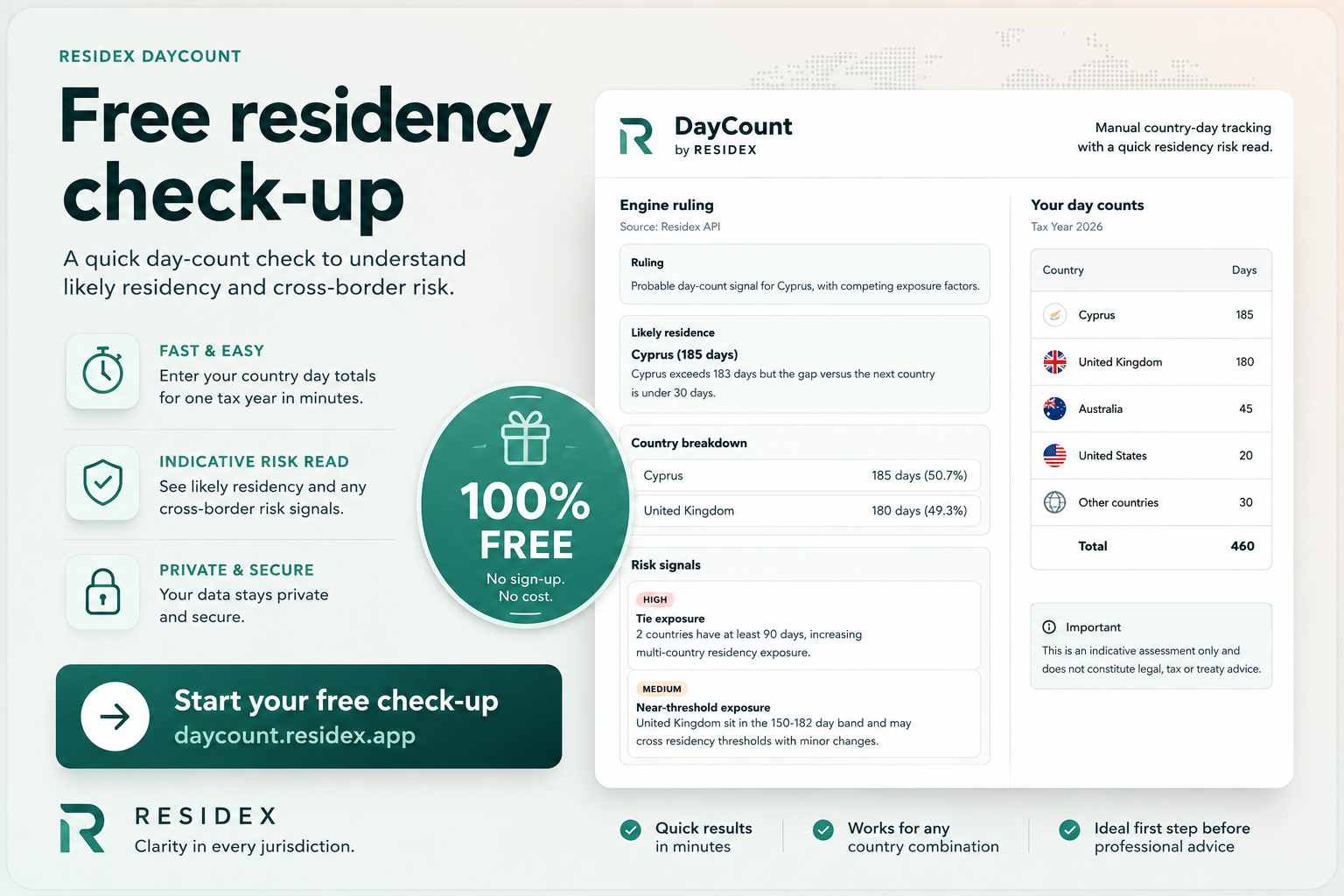
Get your free residency risk assessment.
We developed DayCount to allow you to enter the days you spend in a country and get a free quick residency risk assesment.