
Dual Tax Residency: When Two Countries Think the Client Lives There
Subscribe to our newsletter for the latest expatriate news, views & analysis.
Living internationally can be rewarding, flexible and full of opportunity.
But when your life is spread across more than one country, your tax residency position can become complicated quickly.
Dual tax residency happens when two countries both have reasons to treat you as tax resident at the same time.
One country may look at how many days you spent there. Another may look at where your home, family, work, business interests or regular life is based.
The problem is not always that one country is wrong.
Sometimes both sides can be technically right.
Why dual residence happens
Dual residence often appears when someone’s life is split across jurisdictions.
Common examples include:
you have homes available in more than one country;
your family is in one country but your work is in another;
you run or direct a business across borders;
you travel back regularly to the same country;
you relocate but keep strong ties to your previous home;
your passport stamps, leases, calendars, travel records and tax filings do not tell a consistent story.
A simple day count can help, but it does not always answer the full question.
Tax residency is not only about where you were. It can also be about where your life, assets, obligations and personal connections point.
Why 183 days is not the whole answer
Many internationally mobile people assume that staying below 183 days in a country means they are automatically safe.
That can be a dangerous assumption.
Day counts are important, but many countries also consider other factors, such as:
whether you have a home available;
where your spouse or family lives;
where you work or manage a business;
where you habitually return;
where your economic and personal ties are strongest.
That means you can spend fewer than 183 days somewhere and still have a tax residency issue.
It also means two countries may both have a basis to claim you as resident.
Where tax treaties come in
If two countries both treat you as resident under their domestic rules, a double tax treaty may help decide where you are treated as resident for treaty purposes.
These treaty “tie-breaker” tests often look at factors such as…
permanent home;
centre of vital interests;
habitual abode;
nationality;
agreement between tax authorities where needed.
But this is not just a box-ticking exercise.
The conclusion needs to be supported by evidence.
Why evidence matters
In a dual-residence situation, it is not enough to simply say where you think you are resident.
You may need to show…
where you spent your time;
what homes were available to you;
where your family and personal ties were;
where your work or business activity took place;
which facts pointed to each country;
why one conclusion was reached over another.
For individuals, this matters because poor records can make it harder to explain your position later.
For advisors, it matters because a residency conclusion needs to be clear, reviewable and defensible.
Where spreadsheets fall short
A spreadsheet may show that you spent 122 days in one country and 148 days in another.
But it may not clearly show…
that your spouse remained in one country;
that you had homes available in both countries;
that you attended board meetings in another jurisdiction;
that you relocated but kept old ties active;
why certain evidence was accepted, rejected or overridden.
Dual residency is not only a calculation problem.
It is a reasoning problem.
A practical example
Imagine someone relocates from the UK to the UAE.
They spend significant time outside the UK, but they keep a UK home available, return often for business, and have family ties that remain in the UK.
The day count may suggest one story.
The wider facts may suggest another.
In that situation, the important question is not just “how many days were spent in each country?” It is “what does the full evidence trail show?”
How Residex helps
Residex is built to help individuals and advisors bring structure to tax residency analysis.
It helps users…
record country-by-country travel history;
track day counts;
capture important residency indicators;
distinguish declared residency from assessed risk;
document manual overrides and judgement calls;
maintain a clear reasoning trail;
prepare reports that explain the conclusion;
model future travel using scenario planning.
For individuals, Residex helps turn scattered travel records, personal facts and future travel plans into a clearer residency picture.
For advisors, it provides a structured workflow for reviewing complex cross-border cases, testing possible scenarios, and producing client-ready outputs.
This means Residex can support both sides of the residency question:
Defending the past
By keeping an evidence-led record of where someone was, what ties existed, and why a conclusion was reached.
Planning the future
By using the simulator to test how proposed travel, relocation plans or repeat visits could affect the residency position before decisions are made.
Dual tax residency is difficult because the answer may not sit in one number.
Residex helps move from raw travel data to a clearer, evidence-led and defensible residency position… while also helping individuals and advisors plan ahead with greater confidence.
Residex
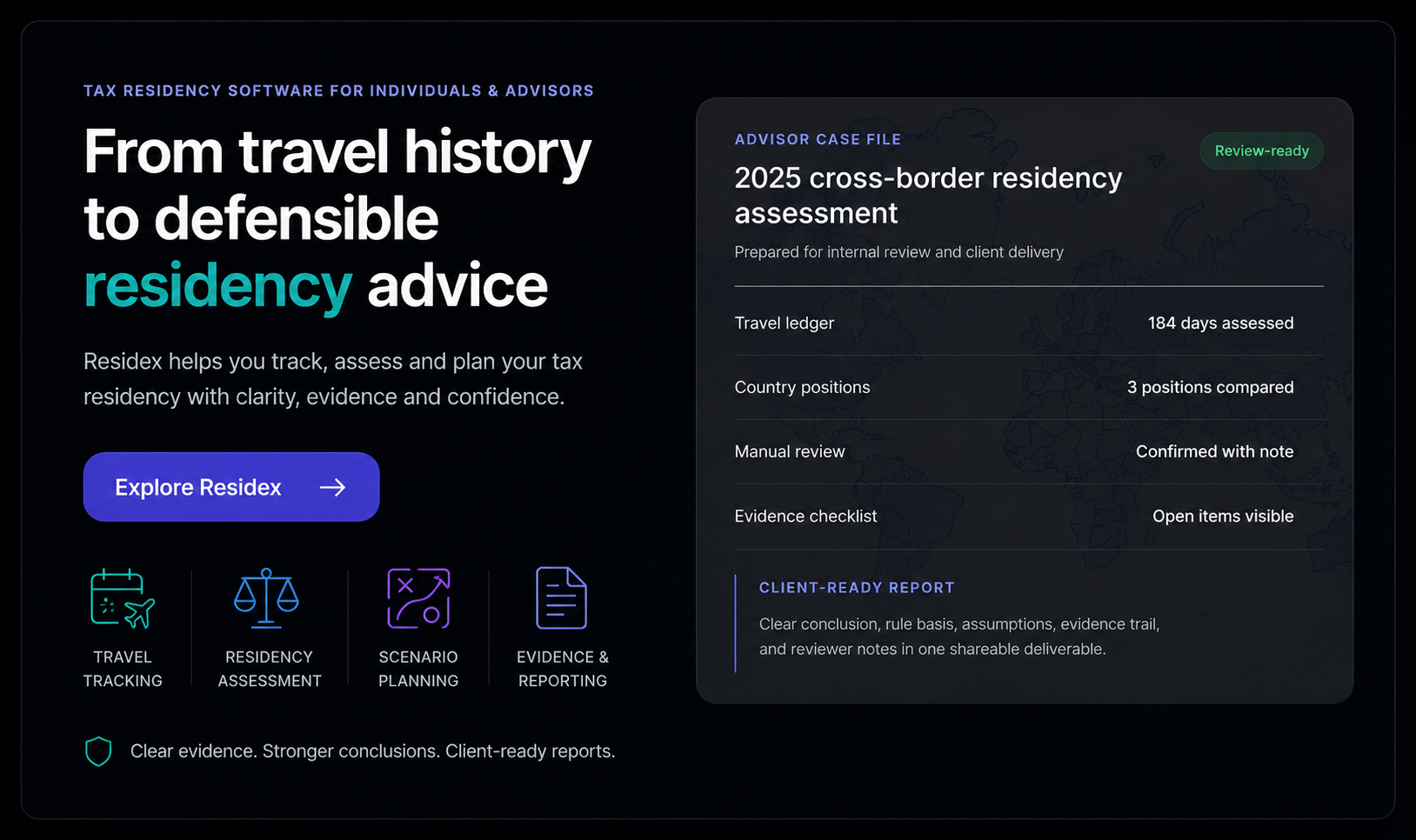
Residex helps you track, assess and plan your tax residency with clarity, evidence & confidence.

Need help & guidance?
Contact us or book a free review with one of our expat experts today.
Get your free residency risk assessment.
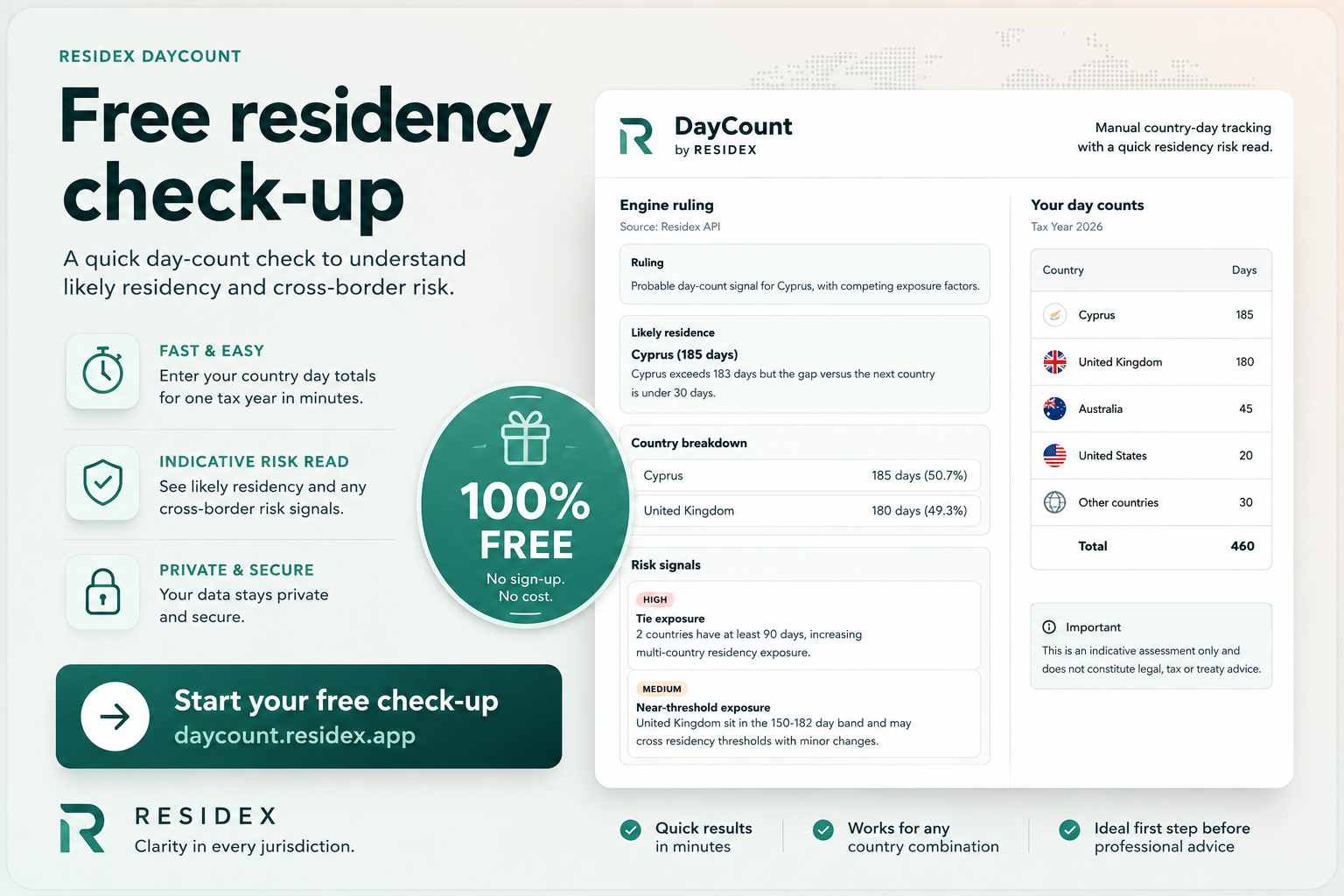
We developed DayCount to allow you to enter the days you spend in a country and get a free quick residency risk assesment.